The Industrial Revolution led to what kind of changes in society?
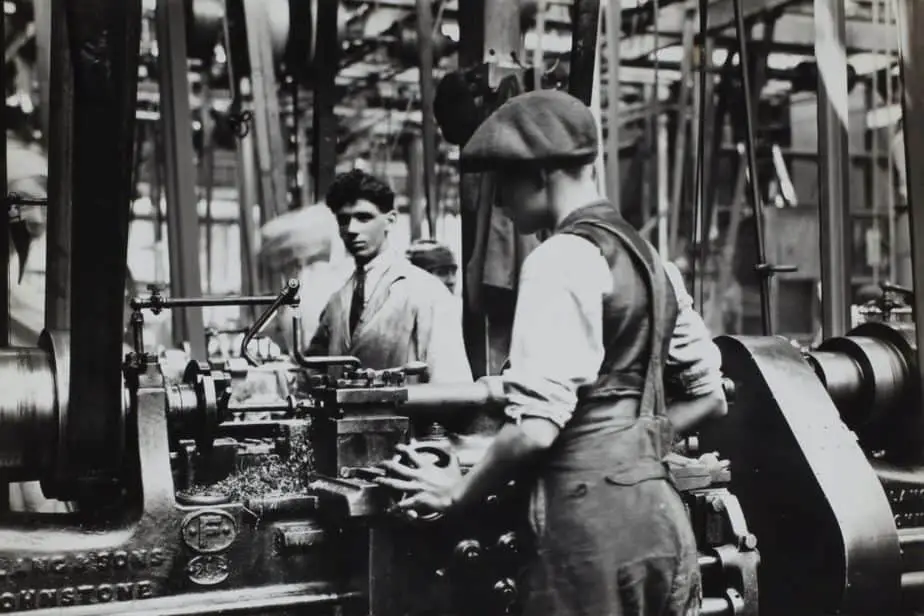
The Industrial Revolution was a rapid evolution of industries, which transpired in England in the belatedly eighteenth and early nineteenth centuries. The period saw the transition to new manufacturing processes from almost 1760-1820 and 1840. This transition included the replacement of manus production methods with machines. The flow is marked by the invention of steam power, spinning jenny, new chemical manufacturing, and iron production processes along with the introduction of the factory system. The Industrial Revolution marked a major turning point in history, which has brought about meaning changes in all walks of life. Today's topic- How Did The Industrial Revolution Change Jobs And Organizations?
Industrialization involved the consummate restructuring of the existing product process. Technological innovations increased tremendously. In add-on to this, work was now organized under a new organization known as the factory system. This new system emphasized the increased division of labor and specialization of functions. With change beingness the new constant in this menstruation, here'south how industrialization impacted jobs and organizations.
Jobs
- Prior to the establishment of factories, nearly every job was predominantly performed past hand. The establishment of factories and the technological innovations of this period made the work a lot easier.
- The menstruation of industrialization brought about meaning changes in the lives of workers in Europe. Skilled artisans now faced potent competition from unskilled workers who started working in the factories.
- Though the period started off with brusque-term job losses, it soon created jobs in different fields that were non-existent previously.
Organizations
- The technological innovations of this period pushed many people towards entrepreneurship.
- The setting up of new factories led to a more organized way of piece of work, witting management of workers, and managers realizing the importance of client relations and learning how to delegate with them.
- The organizational principles were carried beyond the factories to the households. Production operations of this catamenia predominantly centered effectually the households, prioritizing synergistic tasks. At that place was a consummate re-definition of work discipline.
How Did The Industrial Revolution Change Gild?
I fundamental transformation of this period is the work experience. Industrialization led to the formation of a new course in society- the working class. With agronomical laborers embracing factory piece of work, there is rapid migration from the countryside to the urban areas.
With the rise in availability of labor, manufacturing plant workers experienced phases of poverty due to low wages and increased prices of appurtenances. Still, there was another grouping of workers who won small benefits from the industrial revolution and improved their standards of living.
The growing competition forced factories to speed upward their production process, paving the fashion to the imposition of harsh job atmospheric condition. Workers were made to believe that difficult work was the rhythm of life. They were at present governed by strict rules that led to their exploitation.
The industrial revolution completely changed the family structure and redefined the roles of women and children. Gradually, the 'family economy' was replaced past the 'family wage economy' as industrialization caused the growth of wage labor and shift in production, outside the household to factories. With the shifting of production outside the households, there was the removal of work from home.
Families were no longer centers of production, though the transformation was gradual and remnants of older domestic activeness persisted into the 20th century.
The essence of the Industrial Revolution
The Industrial Revolution saw a decisive shift in the methods of industrial production, a historically unique breakthrough in the evolutionary process of technological change, rather than every bit a discrete result occurring in a cursory, sharply demarcated time-span. The distinctive growing points of Industrialization were in the cotton wool, fe, engineering science, car tool, and transport industries.
Even in its early stages, in the last 3 decades of the 18th century, when the step of innovation in these sectors began to gather joint momentum, they carried along with them other less strategically significant industries (such as pottery and newspaper making) which also began to modernize their modes of product.
The cotton industry presented the about dramatic example of rapid transition from a traditional, loosely organized, geographically dispersed, putting-out system of production, dependent on hand-tool technology, to a centrally managed and centrally located manufacturing plant organization using large-calibration machinery, powered by intimate sources of energy.
Advantages And Disadvantages of Industrial Revolution
Just similar every coin has two sides, the industrial revolution has its own share of advantages and disadvantages.
Advantages
- The coming of the industrial revolution saw an increase in employment opportunities. People started earning more by working in factories.
- With the ascension in new establishments, in that location was an increased accent on administration and management. This created a need for skilled employees, increasing the chore supply and overall wages.
- The industrial revolution completely changed the living standards of people. The new technological innovations fabricated piece of work unproblematic.
- The poor working conditions and exploitative work laws gave rise to the formation of labor unions that made the lives of workers ameliorate.
- Equally factories were located in cities, the migration of workers to cities resulted in the rapid expansion of the cities and improvements in city planning.
- Equally innovation received swell attention, this motivated the people to exist educated and resulted in rapid technological advancements.
Disadvantages
The rapid changes brought by the industrial revolution came with their ain disadvantages.
- The newly created factories provided money and job security. This led to a nifty migration of workers from uncertain agricultural sectors into the factories. This resulted in a shortage of food production.
- Increased migration to cities resulted in overcrowding and unsanitary living conditions for the workers.
- In improver to this, the wastage from the factories increased urban pollution. Liquid waste from the factories was dumped into the rivers and other water bodies. Contaminated water used for drinking resulted in illness among the population. The Government started implementing laws and regulations for the condom of its citizens.
- With families migrating to production houses, it became imperative for every person in the family to work in club to sustain themselves. This forced the working-class families to push button their children to work, leading to child labor.
Decision
The flow of industrialization saw pregnant changes and innovations. By the middle of the 19th century, it was obvious that the technological advances taking place in certain express sectors of tardily 18th-century industry had triggered a continuing process of technological and organizational change that had already transformed the grapheme, structure, and productive potential of the whole economic system.
Source: https://howigotjob.com/articles/how-did-the-industrial-revolution-change/
0 Response to "The Industrial Revolution led to what kind of changes in society?"
Post a Comment