Born Again You Were Translate Scripture
LET ME Brainstorm with my own heresy. I recently published a book called Poets of the Bible: From Solomon's Vocal of Songs to John'south Revelation. There are poems lurking everywhere in our two Testaments and yet, the iniquity is in collating the whole Bible into one concise poetry anthology. Verse is often concealed in prose, equally we know — think of Whitman, who found his paradigm for free poetry in scripture. In that location were many before him of class, including John Milton, and many later, like Emily Dickinson and Dylan Thomas. Poems grow in the Bible like spring blooms. My task, equally I saw information technology, was to liberate hundreds of them from Genesis to the astounding Revelation. I was thrilled to try to plough then much dazzler, tale, and idea into English poetry. Tip off the inquisitors, but a holy tree and verse resides in Eden:
So the lord God casts a deep sleep on the man
And he sleeps. Then he takes one of his ribs
And closes up the pigsty with his flesh,
And the rib the lord God takes from the man
He makes into a adult female and brings her to the man.
And Adam says, "She is the bone of my bones."
My heresy is, of course, quite different from what the early translators of the Bible went through — the men who did the pioneer dirty piece of work of turning Hebrew and Greek scriptures into English rather than the authorized Latin. The heresy at that place was opening upward the text to commoners, who would be able to read the Bible on their own for the first fourth dimension. The history of these early Bible translators is like the history of religious wars: ii sides in horrible conflict over religious choice. Too, these early on translators lived and died according to prevailing doctrine. For their iniquity, the brave decoders were oftentimes mortally punished, though today these vile scholars are celebrated.
The history of Bible translation is equally terrible equally it is enthralling. Terrible because of the courageous translators' torture and death and enthralling considering in the history of the translator, as in state of war, we detect deadly battles over ideas. War, of course, dominated the European continent for much of early modern history. In Western Europe, from 1524 to 1648, religious wars continuously roared on between Roman Catholics and Protestants: we take the Eighty Years' War in the Lowlands (1568–1648), the French Wars of Faith (1562–1598), the Thirty Years' War (1618–1648), and the English Civil War (1642–1651). These civil and international wars annihilated national and daily being; populations suffered and diminished. Losses in the millions were non uncommon during those years: iii million people died during the Crusades, the great war between Christianity and Islam.
At the aforementioned fourth dimension, clergy and scholars were waging a hot war over Bible translation. The clergy wished to maintain exclusive noesis of the text while scholars sought to open the Bible to the mutual reader. These scholars, however, even if they were professors at Oxford or Cambridge, were completely unprotected by their institutions. One of these men was John Wyclif (ca. 1330–1384), master of Balliol College at Oxford. Wyclif, known as the "flower of Oxford scholarship" ventured the first translation of the Bible into English. Poor sap — to be so virtuous and mettlesome! Wyclif actually knew no Hebrew or Greek, so relied on Saint Jerome's Latin Vulgate to make his way. This blasphemous human activity — making the Bible heard and read in mutual English language, not Latin — fabricated him a criminal.
In 1401, Archbishop Arundel fumed at Wyclif: "The pearl of the Gospel is scattered abroad and trodden underfoot by swine. […] This pestilent and wretched John Wyclif, of cursed memory, that son of the old snake!" Wyclif merely escaped prosecution by dying just in fourth dimension. His Oxford colleagues however were all burned alive. Even xl years after his expiry, his basic were dug up, burned, and thrown into the River Swift. And yet, in some ways, he had the final laugh. After his decease, Wyclif's manuscripts were twice as pop as Chaucer's Canterbury Tales. (Lordy, what he endured in life!)
A century after, linguist William Tyndale translated scripture direct from Hebrew and Greek into English: a mammoth "do non." Tyndale followed and imitated the scholar Erasmus, saying that he wished "the word to achieve the eyes of all women, Scots and Irishmen, fifty-fifty Turks and Saracens, and especially the farm worker at the plow and the weaver at the loom." Tyndale was roundly denounced. Sir Thomas More scorned the traitor: "The devilish drunken soul […] this drowsy grubber hath drunken so deep in the devil's dregs that if he wake and repent himself the sooner he may hap, ere zero long, to fall into the mashing-vat, and plough himself into draf, equally the hogs of hell shall feed upon." (It's surely worth dying to bask such magnificent slander.)
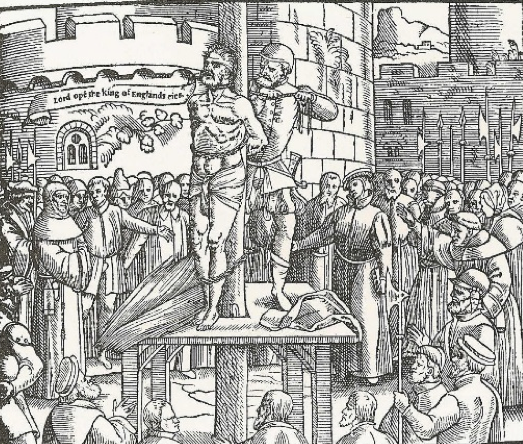
Tyndale did at to the lowest degree manage to translate nigh of the New Testament into cute common English by 1525, just he did not live to finish his overall project. Henry Viii decided that Tyndale had violated canon law: Latin lonely was the accustomed tongue for scripture in translation. While Tyndale was perfecting his noesis of Hebrew to bequeath us the Old Attestation (the Tanakh) he was captured by Henry'due south troops. Tyndale was so strangled and burned at the pale. Horribly, Tyndale'south death was sentenced by the king who would somewhen legalize the translation of the Bible into vernacular English. Once Henry converted to Protestantism and established the Church of England, information technology became okay to interpret Bible into English — as Luther did into colloquial German. The dead Tyndale was not simply the king'southward hero, only the Tyndale Bible likewise became the near pop volume in England.
Once the Church of England came to dominate the empire, it established a measure of peace, if not Cosmic freedom or joy. When King James ordered 47 translators to piece of work on a new translation of the Bible, they completed their work without fear. Of class, those translators gave us the magnificent Rex James Version of the Bible, which was completed in 1611. Similar Shakespeare's plays, the King James is a vast source of story, thought, and spoken communication and it is further proof to the skill of the people who shaped it: the smashing translator creates bang-up literature.
Fifty-fifty in our modernistic times, translation can yet be a fraught and difficult job. Wars accept not diminished and translators — those who allow us to communicate between enemy lines — are oft caught in the crosshairs. Translations of the Bible in item are still strangely contested. In 1930s Texas, a school board voted to publish the Bible in Spanish for immature Latino schoolhouse children. Governor Ma Ferguson shot them downward. Holding upwardly the King James Version, she famously (supposedly) stated, "If the King's English language was good plenty for Jesus Christ, it's good enough for the children of Texas!"
Am I threatened today? No luck. I've missed my century of fire. I could even translate the Bible into Sus scrofa Latin if I wanted to. I might exist called a nut, only no ane would give an unholy damn. It about makes me yearn for more perilous times — now 1 is judged by the quality of work. But information technology seems similar my racket of translating the Greek and Hebrew Bible is condom fifty-fifty if I prefer plain literary English language in place of Bible-speak — the pious jargon that prevails in our endlessly revised "Revised Versions."
Yes, today, alas, my bones will not be dug up and burned. And then exist it. I pray instead for the translators and poets who came earlier me and who allowed the verse in the Bible to breathe and see light.
¤
Willis Barnstone, professor, poet, and scholar, is the author of 80 volumes, including The Restored New Testament, The Gnostic Bible, The Poems of Jesus Christ, The Poetics of Translation, and Mexico in My Heart: New and Selected Poems. He lives in Oakland, California, and Paris.
Source: https://lareviewofbooks.org/article/the-bloody-history-of-bible-translators/
0 Response to "Born Again You Were Translate Scripture"
Post a Comment